It was nearly a week later when I finally sat down to tell the story. It had taken that long to recover. Not just physically, but mentally too. The ride had started as a big beautiful loop I was excited about and ended as something else entirely.
The week leading up to it had already been noisy. The washer broke. The smart bulbs in my house disconnected and refused to reconnect no matter what I tried. I lost an entire Friday fighting Wi-Fi lights. The ceiling fan died. One of the caster bearings on my wheelchair exploded and I was down a wheel for a few days until parts arrived. None of it was catastrophic. It was just friction. Small problems stacking up and quietly draining bandwidth.
Sunday morning I had a plan. I’d been riding a 35-mile route from home that’s about 70% dirt, which is remarkable considering I live in the eighth largest city in the country. It’s a total Suffer Fest, but I love it. The weekend before, friends had shown me Puma, a trail I had never ridden off the Trans County Trail east of Los Peñasquitos Canyon (PQ). I’d also ecently discovered I could ride a trail called Underworld on my new bike and could add it all this route. So I drew a bigger loop linking Puma and Underworld together. It would push closer to thirty-eight miles. I love big, beautiful loops!
I woke up at 7:47, which never happens. I’d slept nine and a half hours and lingered with coffee, scrolling, designing bike ideas in Photoshop. Time slipped. I was already behind before I’d even started. I still had to draw a full hormone dose because I’d forgotten my injections all week. Testosterone is thick; it takes time. I had to swap vehicles to use the Subaru with the bike lift, run through maintenance, and then I discovered my electronic shifting battery and back battery were dead. The charger was failing, so I waited for enough charge to ride. By the time I finally rolled out of the staging spot in Del Mar, it was after one in the afternoon.
Looking back, I stacked variables from the start. A late departure, a longer route, some exploratory linking, darker lenses instead of clear ones, and no lights in my pack. I knew better on all of those.
The ride began well. Road miles through Del Mar felt smooth. I hit the PQ North Side Trail west to east for the first time and rode it clean. The semi-technical trail, Two Bridges, went perfectly. The Trans County north side flowed. Puma, which I’d been most excited about, rode beautifully. Tight switchbacks, one small reverse adjustment, a steep section I’d needed help on before — I cleared it all. I was feeling strong and confident.
At mile twenty-one, near Ted’s, I got a flat. It sounded like a major blowout. My brain immediately jumped to logistics. If I couldn’t fix it, someone would have to retrieve my spare key fob from my desk at home, drive to my car in Del Mar, unlock my wheelchair from the lift at my car, figure out raising the lift on the back of the car, drive to get me, and figure out how to extract me. It would be complicated. I forced myself to slow down. I unstrapped carefully, making sure my foot didn’t get caught and break my leg on the way down, and sat on my cushion on the gropund. It was my first time plugging a tubeless tire myself. I inserted a bacon strip, watched the sealant bubble, and it sealed. A small but meaningful win.
It took longer than expected to get back into the bike because the ground angle made leverage awkward, but eventually I was rolling again. By then it getting close to four o’clock. The sun was noticeably lower.
Climbing Ted’s on the new bike proved more difficult than on my old one. The new setup handles steep and loose terrain differently. I got stuck and needed a push from a hard-of-hearing hiker. We communicated through gestures and figured it out. Shortly after, my crank stopped turning entirely. For a moment I thought the bike was done, started going through the logistics of a rescue again. I decided to push harder — I need too get rescued anyway so doesn’t matter if it breaks — a ditch all last attempt. The cracked plastic casing snapped back into place. The crank turned again. Another unexpected win!
I finally hit the 56 bike path, stopping to check the map and get my bearings — another clock sucker — and cranked west, gaining miles fast being on pavement. Underworld was next. It was getting dark, but I told myself I was only about five miles from the car. As I passed under Del Mar Heights Road, a hiking couple looked at me confused. They probably were wondering why I was out so late. I cleared the two known crux sections perfectly. That confidence tipped into overconfidence. With darker lenses in fading light, I approached a section with a rock on the left and a bush on the right. Instead of straddling the rock, I tried to go around it. My right wheel rode up the bush and I flipped hard at speed. It was a bonehead move, especially so close to home.
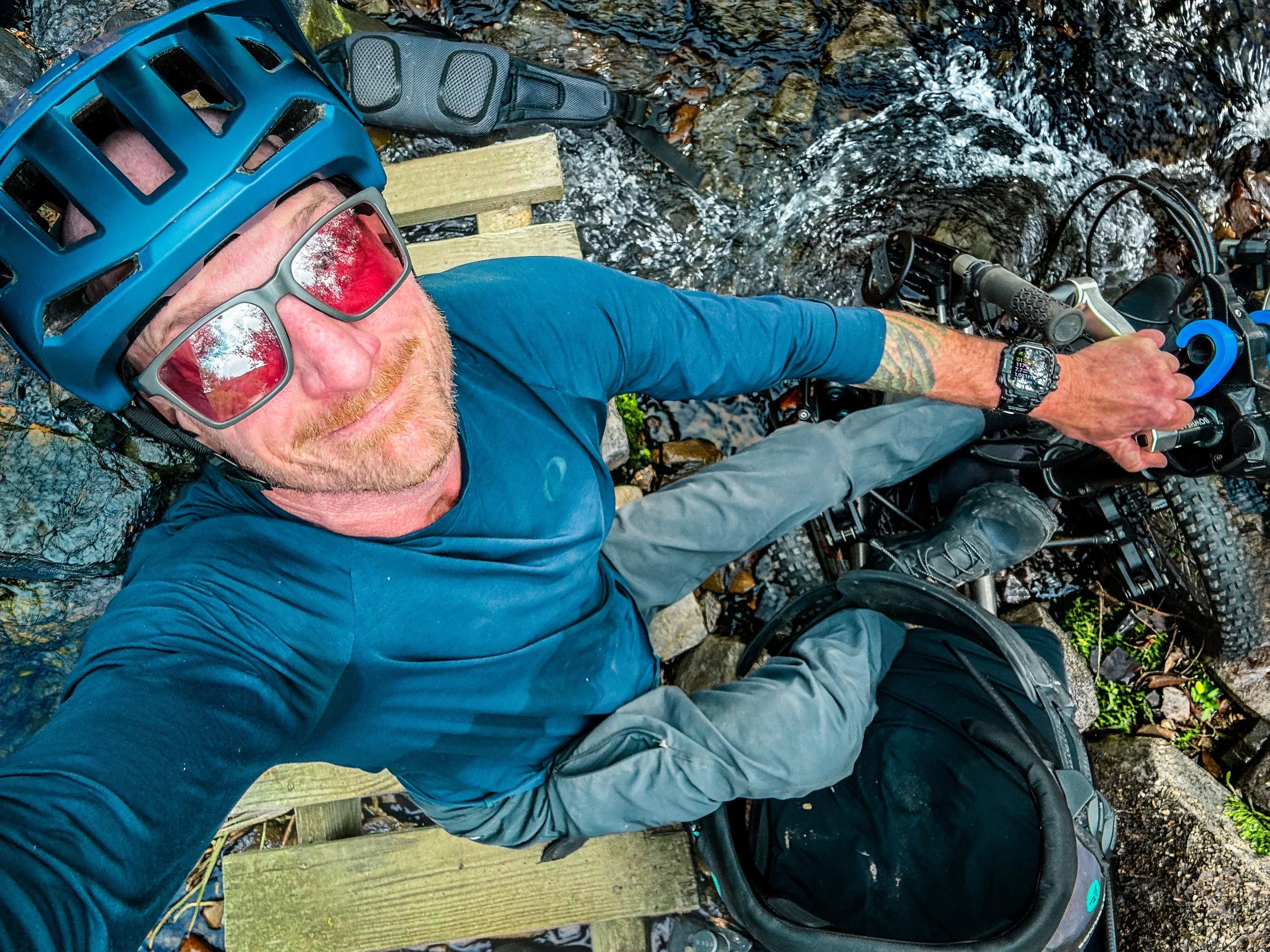
I got out, pinned the bike upright, and remounted, but the cracked crank casing was now hanging loose and catching cables. It was nearly dark. Then I reached the creek crossing. It had rained hard four days earlier. I carried momentum into a blind turn remembering that speed helped the last time I rode it. The bridge was half washed out. I hit what remained and it collapsed beneath me.
I flipped into stagnant creek water about a foot and a half deep, submerged to mid-torso. My bike was almost completely underwater—batteries, charge ports, computer, and electronic shifting all submerged. There was no choice but to deal with it. I unstrapped and got out carefully, sitting in the water while I assessed the situation. To flip the bike I needed the pin that locks out the angulation. My hands were cold and numb. I dropped the pin into the creek.
I had to find it.
With eyes closed in the dark, I searched through mud and debris in widening circles. It felt like forever—at least seven or eight minutes—before I finally felt the metal between my fingers. That moment alone felt like a victory. I pinned the bike and flipped it, lifting 110 pounds from a floating position without a stable lower-body base. It took multiple attempts to get the wheels up onto the bank. The bike wedged against a bush, and I had to drag it sideways without re-tearing my recently torn bicep. Eventually I freed it and inched it little by little over to me.
This process took about an hour. It was now dark. A chorus of frogs beginning to sing all around me, one by one. I fought of a creepy feeling and transferred back into the bike.
I turned it on.
It worked.
Soaked and freezing, I rolled out. The gears didn’t shift at first, leaving me stuck in one gear through deep sand. Just before a steep climb, the shifting suddenly started working again. I crawled through the rest of the trail cautiously. At the G-out near the trail’s end — a steep drop and climb that requires full commitment — I hesitated slightly in the dark. The speed, not being able to see freaked me out for a split second and I didn’t make it up. I got stuck about ten feet from the top and yelled for help. Three young men from nearby houses hiked top me with headlamps and gave me a push start. I pedaled through my gears and made it.
From there, I faced half a mile of El Camino Real with no bike lane and no lights. Cars approached from front and back, converging. I knew they couldn’t see me. I cranked as hard as I could. Arms burning. This mile 35 and I had just come out of an hour fight with a creek. I had to decide quickly whether to throw myself into a ditch on the right, hold my line and hope the car coming up behind didn’t swerve into the other, or dart across to the trailhead in front of both of them. I darted across and threaded the needle.
Now I was home free! Or so I thought. The rest of the path should have been simple, but stadium lights blinded me and my right hand was partially numb from the cold. Highway headlights destroyed what little night vision I had left. I crept along until, six hours after starting, I finally reached the car. The key fob worked! There was no parking ticket. That felt like another small mercy.
I loaded the bike onto the lift one small step at ta time. I was wrecked from what felt like a wrestling match with a grizzly bear. I was shaking, soaked, and likely borderline hypothermic. Driving home, I realized I probably shouldn’t have been driving. I was foggy and impaired. I backed up my steep driveway in the dark with the bike blocking my rear camera and finally got inside, stripped muddy clothes, and sat under a hot shower.
Monday I was still wrecked. Tuesday I was physically better but emotionally drained. The ride wasn’t epic. It was a series of stacked decisions, small recoveries, and a few inches of margin that could have gone differently.
In retrospect, there were avoidable choices: leaving late and keeping the long route, wearing tinted lenses, not carrying lights, choosing the creek crossing instead of the cobbly bypass, riding too fast before the crash, hesitating at the G-out. None of those variables were forced.
I got lucky more than once. But I also kept solving, kept moving, and got myself out.
Sometimes resilience isn’t dramatic. It’s just making the next decision correctly when the margin is thin and no one is watching.
LISTEN TO THE PODCAST